Cat body language is your cat’s primary way of communicating with you, and learning to read it changes everything about your relationship. Because cats rarely vocalize as frequently as dogs, cat body language — through tail position, ear angle, eye expression, and posture — carries most of the conversation. Here’s your complete, practical guide to understanding exactly what your cat is saying.
Why Understanding Cat Body Language Matters
Recent research published in Applied Animal Behaviour Science confirms that cats maintain an independent but functional relationship with humans — one communicated largely through subtle physical signals rather than vocalizations. Misreading cat body language is one of the most common reasons owners feel their cat is “unpredictable” when in reality, the cat was signaling clearly all along. The International Cat Care organization notes that cats who feel understood by their owners show significantly lower stress-related behaviors.
The Tail: Your Cat’s Most Expressive Tool
Cat body language starts with the tail, which broadcasts emotional state almost constantly:
- Tail held high, tip curling slightly — Happy, confident, and friendly. This is your cat saying hello.
- Tail puffed up like a bottle brush — Fear or extreme agitation. Your cat feels threatened.
- Tail low or tucked under — Anxiety, submission, or discomfort.
- Tail lashing or thumping rhythmically — Increasing irritation or overstimulation. Stop petting immediately.
- Tail gently wrapping around you or another cat — Affection and social bonding.
Ear Positions: The Mood Barometer
Ear position is one of the fastest cat body language signals to read in real time:
- Ears forward and slightly outward — Relaxed, curious, or interested
- Ears straight up — Alert and attentive
- Ears rotated sideways (“airplane ears”) — Mild anxiety or conflict between curiosity and caution
- Ears flat against the head — Fear or aggression — this cat is feeling seriously threatened
Eye Signals: Slow Blinks and Beyond
Cat body language includes some of the most nuanced eye signals in the animal kingdom:
- Slow blink — Trust and affection. When your cat slow-blinks at you, they’re signaling comfort and safety. Slow-blinking back is one of the best ways to deepen your bond.
- Dilated pupils in a calm situation — Excitement or mild anxiety
- Dilated pupils alongside tense body — Fear or aggression
- Half-closed, relaxed eyes — Contentment and comfort
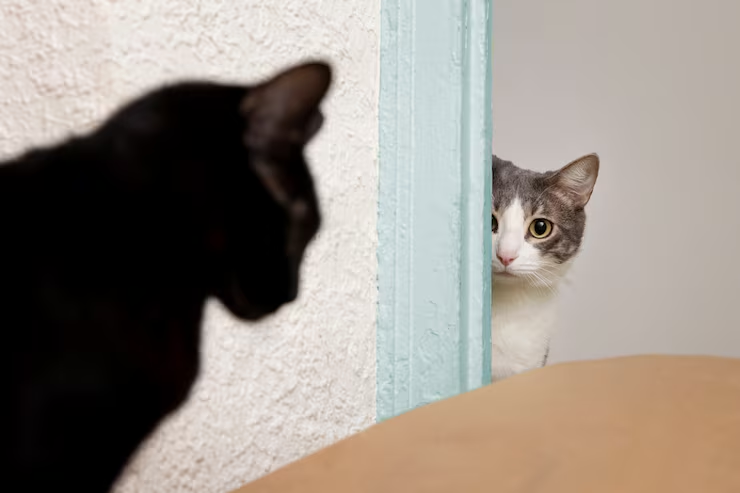
- Hard, unblinking stare — A challenge or threat signal, especially toward other cats
Posture and Body Position
Full cat body language includes the whole posture, not just individual parts:
- Loaf position (paws tucked under, eyes half-closed) — Completely at ease
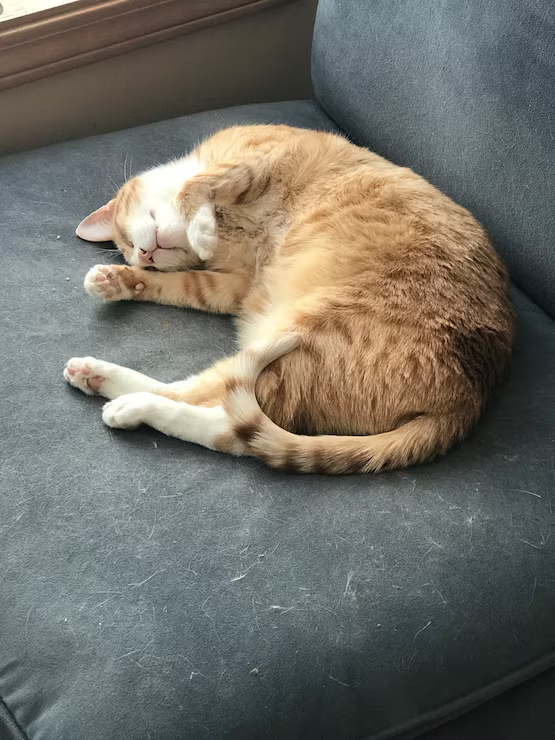
- Belly exposed, lying on back — This is NOT always an invitation to rub. It signals deep trust and comfort, but many cats don’t enjoy belly rubs and will react if touched there.
- Arched back with puffed fur — Defensive fear response, trying to look bigger
- Low crouch with wide eyes — Fear or predatory focus
- Head bunting (rubbing head against you) — Affection and scent marking — your cat is claiming you as theirs
Vocalizations as Part of Cat Body Language
While primarily about physical signals, cat body language works alongside sound:
- Chirping or chattering at windows — Predatory excitement, usually directed at birds or insects
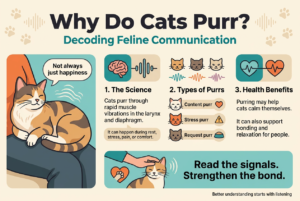
- Slow, rumbling purr — Usually contentment, but cats also purr when stressed or in pain as a self-soothing mechanism
- Trill — A friendly greeting, often used with owners they’re bonded to
- Hissing or spitting — Clear warning: back off
Putting It All Together
Cat body language is best read holistically. A high tail with slow-blink eyes and a relaxed loaf posture means a very content cat. A low tail, flat ears, and dilated pupils mean a cat in distress. Reading individual signals in context prevents misunderstandings that can lead to defensive scratching or biting.
Final Thoughts
Cat body language is one of the most rewarding things you can learn as a cat owner. Once you start reading your cat’s signals accurately, you’ll notice behavior that once seemed random becomes genuinely predictable and understandable. For more on building a strong, happy relationship with your cat, see our Beginner’s Guide to Keeping a Happy Cat and explore our full Cat Behavior section.
If your cat’s body language signals sudden changes in mood or posture alongside other symptoms, a vet check is always a good first step.